

Discover how mitragynine and 7-hydroxymitragynine shape kratom’s effects through science, balance, and natural synergy.
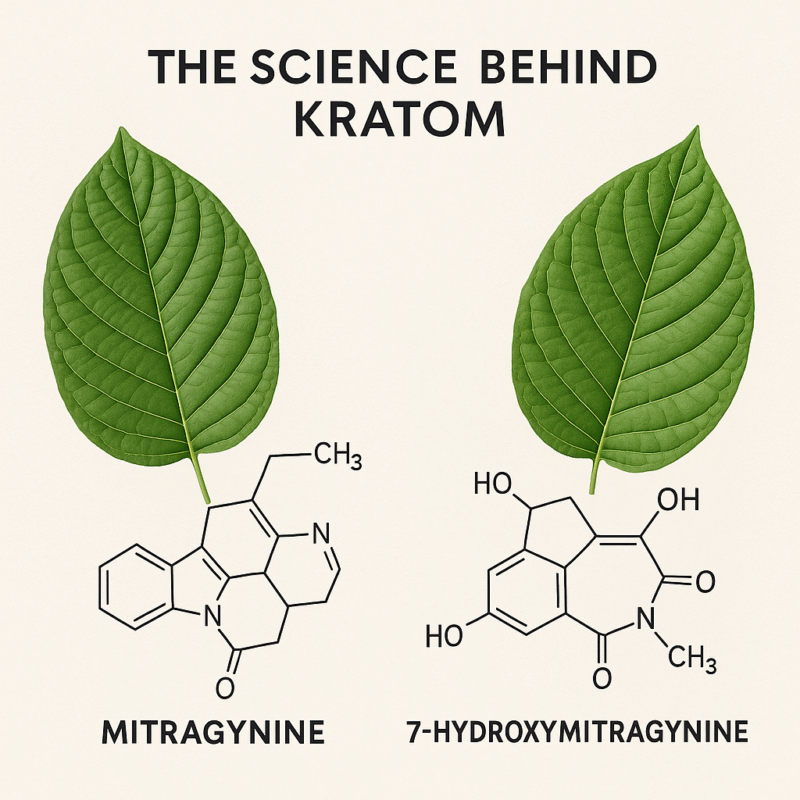
Looking to understand the science behind kratom and what makes it unique among natural botanicals?Two key compounds, mitragynine and 7-hydroxymitragynine, define how kratom interacts with the human body, shaping both its potential and its controversy. These alkaloids are what make kratom’s effects distinct from other plants, and understanding them helps explain why natural kratom differs from extracts or isolates.
What Are Mitragynine and 7-Hydroxymitragynine?
Both mitragynine and 7-hydroxymitragynine are indole alkaloids naturally found in Mitragyna speciosa, a tropical tree native to Indonesia, Malaysia, and Thailand.
- Mitragynine is the most abundant alkaloid in natural kratom leaf, often making up 60–70 percent of total alkaloid content.
- 7-Hydroxymitragynine, on the other hand, exists only in trace amounts (usually less than 0.05 percent) but is significantly more potent in receptor binding.
These compounds interact primarily with the mu-opioid receptors in the brain, but in a partial, not full, way. That means kratom’s effects differ greatly from synthetic opioids, resulting in milder and more balanced experiences that vary by dosage, strain, and preparation method.
How Mitragynine Works in the Body
When people talk about “energy” or “focus” from kratom, they are usually describing mitragynine’s activity.
This alkaloid acts as a partial agonist, stimulating certain brain receptors while keeping others inactive. As a result, it can create an alert but calm state, often compared to caffeine without the jitters.
The balance of mitragynine depends on several factors:
- Leaf maturity (younger leaves have more mitragynine)
- Drying method (sun-drying can slightly oxidize it)
- Storage (heat and moisture can degrade alkaloids over time)
Proper post-harvest handling ensures that mitragynine remains stable and effective, which is why lab-tested kratom from trusted producers matters.
The Role of 7-Hydroxymitragynine in Kratom’s Profile
While 7-hydroxymitragynine is much rarer, it plays a critical role in the science behind kratom’s potency.
During drying and oxidation, a small portion of mitragynine naturally converts into this compound. That is why certain fermented or “red” kratom strains are perceived as more relaxing, since their fermentation process allows slightly higher 7-OH formation.
Unlike mitragynine, 7-hydroxymitragynine binds more strongly to mu-opioid receptors, giving it a faster onset. However, in natural kratom leaf, it remains in extremely low concentrations.
That separation is what distinguishes natural kratom from extract-enhanced products, which may artificially increase 7-OH levels to boost perceived strength. This can lead to dependence and regulatory issues.
Natural Kratom vs Extracts: A Scientific Comparison
Understanding the science behind kratom also clarifies why natural kratom leaf and extract-based products behave differently.
| Aspect | Natural Kratom | Extract or Isolate |
|---|---|---|
| Mitragynine % | 1.0–1.5% typical | Often concentrated above 20% |
| 7-Hydroxymitragynine % | <0.05% (trace) | Artificially boosted to 1–2% or more |
| Effect | Balanced, gradual | Intense, fast-acting |
| Regulatory risk | Lower | Higher, resembles semi-synthetic opioids |
The takeaway is that natural kratom maintains harmony between multiple alkaloids, not just mitragynine and 7-OH, creating what scientists call the entourage effect. This synergy explains why whole-leaf kratom feels smoother and more sustainable for long-term users.
Why Understanding Kratom Chemistry Matters
For anyone using, researching, or selling kratom, understanding mitragynine and 7-hydroxymitragynine is essential. It is not just about potency; it is about safety, transparency, and scientific integrity.
As global regulations tighten, being informed helps distinguish between authentic botanical kratom and lab-altered products. Responsible producers emphasize full alkaloid profiles, clean drying methods, and transparent testing to maintain kratom’s rightful place as a natural plant, not a synthetic extract.
Final Thoughts: A Leaf Worth Understanding
The more we learn about the science behind kratom, the clearer it becomes that this plant’s future depends on education and responsible practices. Mitragynine and 7-hydroxymitragynine are only two pieces of a much larger phytochemical puzzle—one that blends tradition, nature, and modern science.
At Nusa Botanicals, we remain committed to sharing verified, science-based information while supporting ethical, transparent sourcing from Indonesia’s rainforest communities.
Contact us for more information or wholesale inquiry
